Kepler’s Moon Puzzle
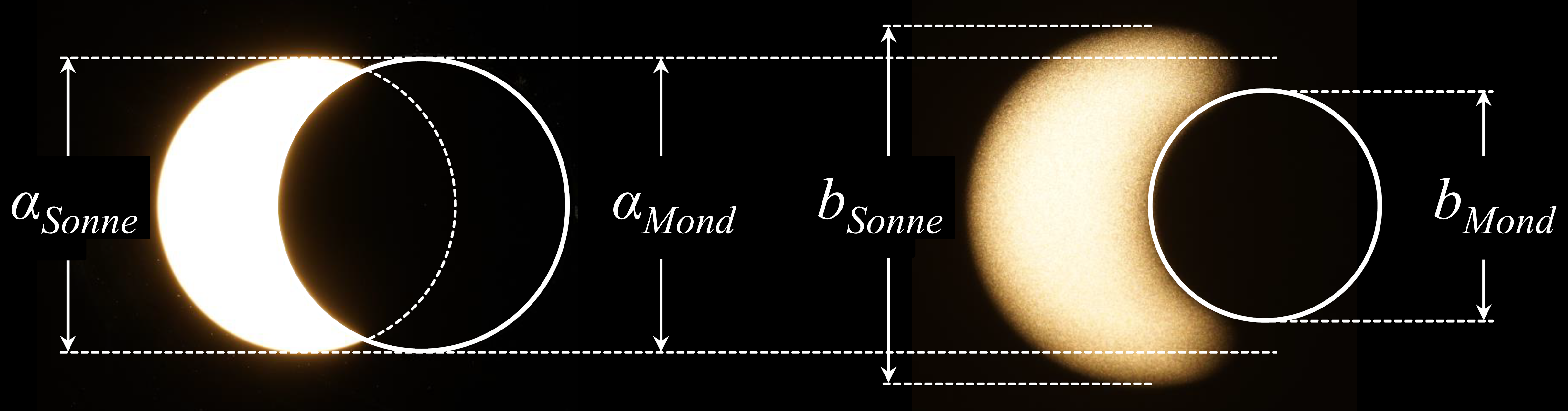
In 16th-century European astronomy, it was common practice to determine the sizes of the Sun and Moon using a pinhole camera. Yet calculating the Moon’s diameter from the concave edge segment of the partially covered Sun produced puzzling results—an issue that remained unresolved as long as no precise theory of the pinhole camera existed that correctly accounted for the influence of the aperture. Alerted by these inconsistencies, the young Johannes Kepler carried out measurements during a solar eclipse in Graz on July 10, 1600. Shortly thereafter, he developed a comprehensive theory of the pinhole camera that remains valid to this day.
On the history of the Moon puzzle
-
Grebe-Ellis, J. & Quick, T. (2025): The Study of Shadows – Kepler’s 'Light Figures' and Pinhole Imaging, Physics Education (in preparation)
Abstract Kepler’s theory on pinhole camera imaging is still valid today, its development is well documented and provides an exciting context for optics lessons. Kepler presented a generalized concept of ’light figures,’ describing the formation of soft shadow images through the interaction between extended apertures and extended light sources. The work marks the culmination of Kepler’s extensive engagement with the ’Moon puzzle.’ In this paper, we examine Kepler’s theory and depiction of ’light figures’ from both historical and experimental perspectives. We provide an overview of Kepler’s theory and its historical context, and present experiments that illustrate Kepler’s theoretical insights, specifically designed for educational use. In this way, a generalized concept of soft shadow imaging can be integrated into optics education, drawing on an authentic historical context.
-
Quick, T. and Grebe-Ellis, J. (2025): Kepler's Moon Puzzle – A Historical Context for Pinhole Imaging, American Journal of Physics
Abstract In 16th-century European astronomy, determining the sizes of the Sun and Moon using a pinhole camera was common. However, calculating the Moon´s diameter from the concave segment of the partially obscured Sun yielded puzzling results due to a lack of a comprehensive theory of the influence of the aperture on the image. This inconsistency led Tycho Brahe to question prevailing assumptions in celestial mechanics. Recognizing this, Johannes Kepler conducted measurements during a solar eclipse in Graz July 10, 1600, and soon developed a theory of the pinhole camera that remains valid today. In this article, we recount the historical episode leading to Kepler´s theory through original works, complemented by a series of illustrative experiments for classroom use. This historical case study offers a rich context for reflecting on Nature of Science aspects within physics education. (Full text)
-
Quick, T. and Grebe-Ellis, J. (2024): Das Mondrätsel und die Erfindung der modernen Optik, PhyDid B – Didaktik der Physik. Beiträge zur DPG-Frühjahrstagung 2024 in Greifswald.
Abstract: In 16th-century European astronomy, it was common to determine the sizes of the Sun and Moon using a pinhole camera. However, deriving the Moon’s diameter from the concave edge segment of the partially covered Sun yielded puzzling values as long as no pinhole-camera theory existed that correctly accounted for the influence of the aperture. Alerted by these inconsistencies, the young Johannes Kepler conducted measurements during a solar eclipse in Graz on July 10, 1600. Only a few days later, he presented in his notes a fully developed theory of the pinhole camera that is still valid today. In the following contribution, we trace the historical path toward the formulation of this theory based on selected original works by Kepler and Brahe and present a series of illustrative experiments suitable for classroom use. The episode from the history of optics also serves as an exemplary case study for reflecting on NOS aspects in physics education. (Full text)